About Five Easy Pieces
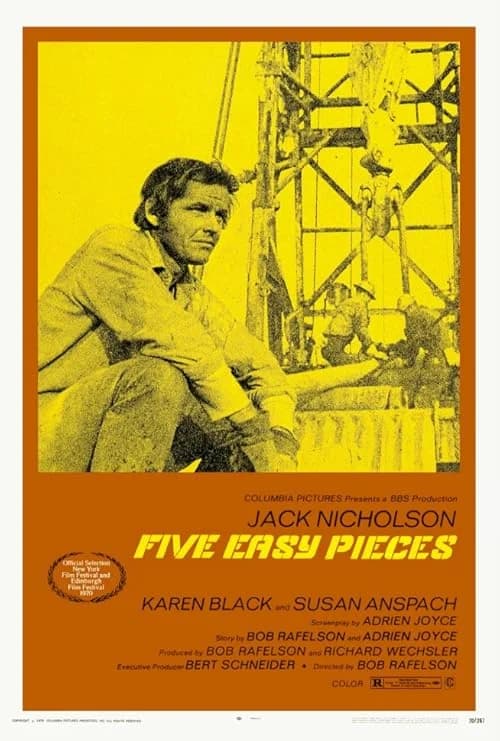
Five Easy Pieces stands as one of the defining American films of the early 1970s, a poignant character study that captures the era's restless disillusionment. Directed by Bob Rafelson, the film features a career-defining performance from Jack Nicholson as Robert Dupea, a former piano prodigy from an intellectual family who has deliberately shed his privileged background. We meet him working on an oil rig, engaging in heavy drinking and transient relationships, embodying a raw, blue-collar existence that seems to reject everything he was raised to be.
The plot is deceptively simple, driven by character rather than event. When Robert learns his father is ill, he is compelled to return to his family's cultured, insular island home with his waitress girlfriend Rayette (Karen Black in an Oscar-nominated role). This journey forces a profound confrontation between the life he has chosen and the world he abandoned. The film's brilliance lies in its nuanced exploration of alienation and the search for authentic selfhood, themes that resonate deeply decades later.
Nicholson's performance is a masterclass in controlled complexity, revealing Robert's intelligence, anger, vulnerability, and profound dissatisfaction in subtle gestures and iconic scenes, like the famous 'chicken salad sandwich' diner exchange. Rafelson's direction is assured and observational, creating a gritty, authentic atmosphere that grounds the existential drama. The supporting cast, including Susan Anspach and Lois Smith, is uniformly excellent.
Viewers should watch Five Easy Pieces for its timeless examination of the American struggle between freedom and responsibility, its exceptional acting, and its status as a cornerstone of the New Hollywood movement. It's a film that doesn't offer easy answers but provides a deeply human and unforgettable portrait of a man forever caught between two worlds.
The plot is deceptively simple, driven by character rather than event. When Robert learns his father is ill, he is compelled to return to his family's cultured, insular island home with his waitress girlfriend Rayette (Karen Black in an Oscar-nominated role). This journey forces a profound confrontation between the life he has chosen and the world he abandoned. The film's brilliance lies in its nuanced exploration of alienation and the search for authentic selfhood, themes that resonate deeply decades later.
Nicholson's performance is a masterclass in controlled complexity, revealing Robert's intelligence, anger, vulnerability, and profound dissatisfaction in subtle gestures and iconic scenes, like the famous 'chicken salad sandwich' diner exchange. Rafelson's direction is assured and observational, creating a gritty, authentic atmosphere that grounds the existential drama. The supporting cast, including Susan Anspach and Lois Smith, is uniformly excellent.
Viewers should watch Five Easy Pieces for its timeless examination of the American struggle between freedom and responsibility, its exceptional acting, and its status as a cornerstone of the New Hollywood movement. It's a film that doesn't offer easy answers but provides a deeply human and unforgettable portrait of a man forever caught between two worlds.